


7 Tips for Navigating the Bay Area Tech Industry in Late 2026
The Bay Area technology sector is moving at breakneck speed. As we cross into the second half of 2026, the local tech market is undergoing a profound structural evolution. While broad headlines often focus heavily on high-profile corporate restructuring, a closer look reveals that companies are actively reorganizing teams, prioritizing artificial intelligence (AI), and focusing intensely on specialized skills.
Even as the tech industry grows coast-to-coast, with the U.S. Bureau of Labor Statistics and Lightcast forecasting the tech workforce to grow twice as fast as the overall U.S. workforce over the next ten years, the Bay Area still leads the pack. According to CompTIA’s State of the Tech Workforce 2026, San Jose and San Francisco remain two of the best-paying and most opportune cities for tech workers to be employed.
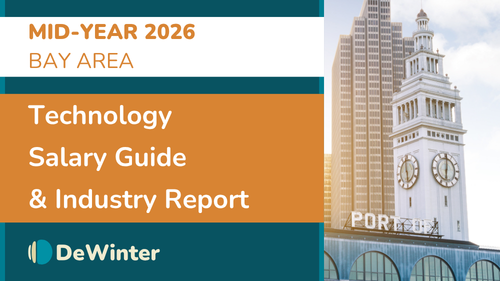
To capture this momentum, DeWinter recently released our 2026 Mid-Year Bay Area Technology Salary Guide & Industry Report. Grounded in local placement data, this report is the go-to tool for hiring managers planning their budgets and candidates seeking to maximize their market value.
Whether you are trying to scale a high-performing engineering team or land your next defining career role, navigating the current landscape requires a highly localized, data-backed strategy. Below, we break down seven actionable strategies for both hiring managers and job seekers to win in the Bay Area tech market in late 2026.
Part I: Strategies for Hiring Managers
1. Benchmark Compensation Against Local Reality, Not National Averages
In a highly competitive hub like San Francisco,relying on generic national databases to determine compensation in San Francisco or Silicon Valley is a fast track to missing out on elite talent.
Using a local guide, like the
DeWinter 2026 Mid-Year Technology Salary Guide, managers should map their team's existing pay structures against local 25th, 50th, and 75th percentiles. Adjusting compensation proactively prevents expensive turnover and ensures your offers stand out to the passive candidates who hold the most leverage.
2. Pay a Premium for "Force Multiplier" AI Skills
Budget constraints are real, but underpaying for specialized expertise is a costly mistake. As of late 2025, 50% of U.S. tech job postings now require AI skills, marking a nearly 100% surge from the previous year, signaling that AI has shifted from an experiment to an essential requirement, according to Dice.
If your team is trying to build or scale, expect to pay a premium for candidates holding proven experience in machine learning architectures, cloud security, and data professionals.
In fact, the
Bureau of Labor Statistics projects that employment for data scientists will grow by an exceptional 33.5% through 2034. When planning your H2 2026 headcount, expect to allocate a premium for candidate profiles with verified expertise in cloud optimization, systems architecture, and automated pipeline security.
3. Leverage "Hybrid Velocity" to Attract Top Talent
The debate over remote work has largely settled, yielding a clear and highly stable standard. Data from Gallup's Hybrid Work Index reveals that 52% of remote-capable professionals now work in a hybrid model, while only 22% are fully on-site.
Key Takeaway: Offering structured hybrid arrangements—such as 2 or 3 days in the office—is a baseline expectation for top performers.
Part II: Strategies for Tech Candidates
4. Build an "AI-Adjacent" Skill Portfolio
While deeply specialized machine learning researchers are highly sought after, there is an equally massive demand for software developers who can successfully implement and operationalize these models.
Analysis from the Bipartisan Policy Center (BPC) July 2026 Report shows a tremendous year-over-year surge in postings requiring specific AI execution capabilities. Software publishers and system design services have seen demand for AI skills grow by 54% and 43%, respectively. To make your resume stand out in H2 2026, highlight your experience working with large language model (LLM) APIs, building Retrieval-Augmented Generation (RAG) systems, or managing data orchestration pipelines.
To elevate your resume:
- Incorporate AI frameworks or machine learning integrations into your current projects.
- Highlight experience with cloud infrastructure (AWS, Azure, GCP) or data pipelines.
- Acquire in-demand credentials, such as AWS Certified Cloud Practitioner or Certified Cloud Security Professional (CCSP).
5. Transition From "Scattershot" to Project-Style Job Hunting
Applying to 100 random quick-apply job posts is an ineffective strategy in today's market. Recruiters and hiring managers are looking for highly targeted matches.
Instead, treat your job search like an engineering sprint:
- Target and Research: Build a curated list of 15 to 20 local companies whose tech stacks and products align with your strengths.
- Tailor Your Story: Adapt your resume to speak directly to the business problems those specific companies are facing.
- Map Compensation Early: Use the
DeWinter Salary Search Tool to identify where your skills and years of experience sit in the local percentile brackets. Entering discussions with hyper-local, data-backed salary expectations establishes immediate professional credibility.
6. Emphasize "T-Shaped" Capabilities in Interviews
Hiring managers in 2026 are highly risk-averse; they want individuals who can drive projects across the finish line with minimal ramp-up time. Successful candidates are showcasing "T-shaped" profiles: deep technical expertise in one core area (the vertical bar) paired with broad collaboration and communication skills (the horizontal bar).
During your interviews, don't just explain
what you coded. Describe the business outcome: How did your work reduce cloud spend? How did it accelerate release cycles? By connecting your technical skills directly to business efficiency, you position yourself as an indispensable asset.
7. Keep Pace with In-Demand AI Job Titles and Local Salary Ranges
Artificial intelligence has matured from an experimental initiative to a foundational layer of modern software architectures. This shift has created highly distinct job profiles, each commanding unique pay ranges in the competitive Bay Area landscape.
The BPC Skills Dashboard highlights that core skills like Machine Learning Operations (MLOps)—the practice of maintaining and scaling deployed models—have seen a 56% to 67% year-over-year increase in job postings.
To keep both hiring managers and candidates aligned on fair market rates, the DeWinter 2026 Mid-Year Technology Salary Guide & Industry Report tracks local compensation data for the top 12 AI and machine learning roles.
Whether you are budgeting to hire an NLP specialist or looking to negotiate an offer as an MLOps Architect, referencing these regional salary figures ensures you are operating with the most accurate, realistic data in the Bay Area.
Navigating the Second Half of 2026
The Bay Area remains the undisputed epicenter of global technology innovation. While the market demands more precision than it did a few years ago, the opportunities for career acceleration and high-impact hiring are immense. Navigating this environment successfully comes down to having local, verified insights.
Ready to dive deeper into local compensation trends, in-demand skills, and hiring strategies?
Discover 6 proven strategies to scale your Data, AI, and Intelligence teams in 2026. Read DeWinter's guide for top hiring and technology talent insights.

How CFOs Are Rethinking Talent, Tech, and Growth in 2026: 5 Trends Every Finance Leader Should Know

AI hiring is surging in 2026. Discover the top 5 high-demand AI roles driving tech recruitment, required skill sets, and tips for candidates and employers.

DeWinter placed a Director of Finance at a VC Biotech Health startup to plug cash leaks, manage burn rate, and scale operational FP&A.
DeWinter turns 26! Celebrate our 2026 achievements, including 100K LinkedIn followers, an AI Transformation practice, and top SIA staffing awards.

Navigating a tech job offer in 2026? Ask these 6 essential questions about equity, remote policy, and stability before signing in the Bay Area.
DeWinter named to SIA’s 2026 Largest Staffing Firms in the US. Discover why top companies trust us for elite finance, accounting, tech, and AI talent.

Discover how AI is reshaping Boston’s finance and accounting jobs. Get real 2026 hiring trends, salary insights, and key skills from DeWinter'sexperts.
DeWinter has been officially named one of the Best Places to Work in the Bay Area for the fourth consecutive year by the San Francisco Business Times and Silicon Valley Business Journal

Ready to unlock true enterprise ROI? Discover what to look for in an AI transformation partner and how executives can confidently scale AI safely.